
I first wrote about Uber in December 2024 and updated my model again last June. At the time, I came out with a fair value of $115.03 per share, which implied about 36% upside versus the $84.76 the stock was trading at then.
Fast forward fourteen months, and Uber closed at $78.03 on 10 August 2026. That’s roughly 8% lower than where it was when I last ran the numbers, and about 23% off the highs near $101 it briefly touched last autumn.
What’s interesting, though, is that the business itself hasn’t really slowed down.
Over the same period, Gross Bookings went from $162.6 billion to $193.5 billion (+19%), free cash flow increased from $6.9 billion to $10.0 billion (+45%), and GAAP operating margin expanded from 6% to 11%.
The business kept compounding. The stock didn’t.
That disconnect is what pushed me to go back and rebuild the model from the ground up.
A lot has shifted since last June. Some of it strengthens the bull case. Some of it makes things a bit more complicated than they looked a year ago.
Uber One has now passed 50 million members. Advertising has quietly scaled into a $2.5 billion annual run-rate business. And the autonomous vehicle story, which I treated mostly as a tailwind last year, has become a lot less straightforward.
Waymo is now unwinding parts of its exclusive Uber partnership, first in Phoenix, and now set to do the same in Austin and Atlanta from January 2028.
Uber, for its part, has responded by leaning in rather than pulling back: more than 30 AV partnerships, a $1.25 billion commitment to Rivian, and a $14.8 billion agreed acquisition of Delivery Hero that would almost double its delivery footprint.
Let’s get into it.
Financial Model
I’ve kept the same framework as last year. I project cash flows over ten years, discount them at 10% (reflecting Uber’s strong cash generation but still meaningful execution risk), and apply a 2% terminal growth rate.
A 2% terminal growth rate is applied.
Gross Bookings
Gross Bookings grew 19% in 2025 to $193.5 billion, marking the fifth straight year of 20%+ growth on a constant currency basis.
I’m leaving my long-term assumption unchanged at a 10% CAGR, which gets me to about $516 billion by 2035.
Even with the strong recent performance, I don’t feel the need to push that higher. The base is much larger now, and the AV picture (which I’ll come back to) adds both opportunity and uncertainty.
The main drivers remain:
Market growth: The global ride-hailing market is forecast to grow at a 10% CAGR from 2026 to 2035, according to Global Market Insights.
Uber One: Membership has grown from 30 million at the end of 2024 to over 50 million by mid-2026. That’s 20 million additions in about a year and a half. Members now account for more than half of Mobility and Delivery bookings and spend roughly 3x more than non-members.
Autonomous vehicles: Uber now works with 30+ AV partners (up from 18 a year ago) and expects to be live in up to 15 cities by the end of 2026.
Geographic + category expansion: Uber is in 15,000+ cities. If the Delivery Hero deal closes, its delivery footprint would nearly double from 49 to 99 markets (though I’m not including that in the model yet given timing and uncertainty).
Take Rate
Take rate came in at 27% in 2025, flat year-on-year, despite continued growth in advertising. Part of that flatness comes down to a UK accounting change that reclassified certain driver payments, which mechanically reduced reported Mobility revenue.
Adjusting for that, I still see the take rate plateauing around 27% by 2035, slightly below the 29% I assumed last year.
What supports it:
Uber One: More members, higher frequency, and better mix.
Advertising: Now a $2.5 billion run-rate business, growing ~50% YoY (up from ~$1.5 billion last year).
FCF
Operating margin improved meaningfully, rising to 11% from 6% a year earlier. Free cash flow followed, reaching $10.0 billion versus $6.9 billion, or a 19% margin.
I’ve been a bit more cautious on the forward path.
I now model FCF margins reaching 25% by 2035, down from the 29% terminal margin I used previously.
The reason is pretty simple: Uber is no longer quite as pure an asset-light story as it once was.
The Rivian partnership alone implies up to $1.25 billion of investment into 10,000–50,000 purpose-built robotaxis. The Nuro/Lucid programme adds another 20,000+ vehicles.
Management has described the broader AV effort as a ~$10 billion multi-year programme, with limited near-term P&L impact.
I’m fine taking that at face value for the explicit forecast period. But I’m less comfortable assuming Uber can still reach peak-margin levels from a world where it increasingly has some skin in the physical fleet.
Dilution
A quick note here, because it came up in last year’s comments: buybacks don’t erase dilution in the way people sometimes assume.
Dilution comes from stock-based compensation. That happens regardless of what Uber does with buybacks.
Buybacks are just a use of free cash flow. That cash could otherwise go to dividends, retained balance sheet strength, or acquisitions. So when Uber buys back stock, it’s not creating extra value on top of the model, it’s deciding how to allocate cash I’ve already included in the valuation.
With that in mind, Uber has been buying back stock aggressively, including $3.5 billion in Q2 2026 under a $20 billion authorisation, broadly in line with its ~50% FCF target.
That’s helped offset issuance but I’ve reduced my net dilution assumption from 2.0% to 1.5% annually because the gross SBC-driven share issuance in 2025 was 1.3%.
Still, it’s not neutral. It just means the drag is smaller than before, not gone.
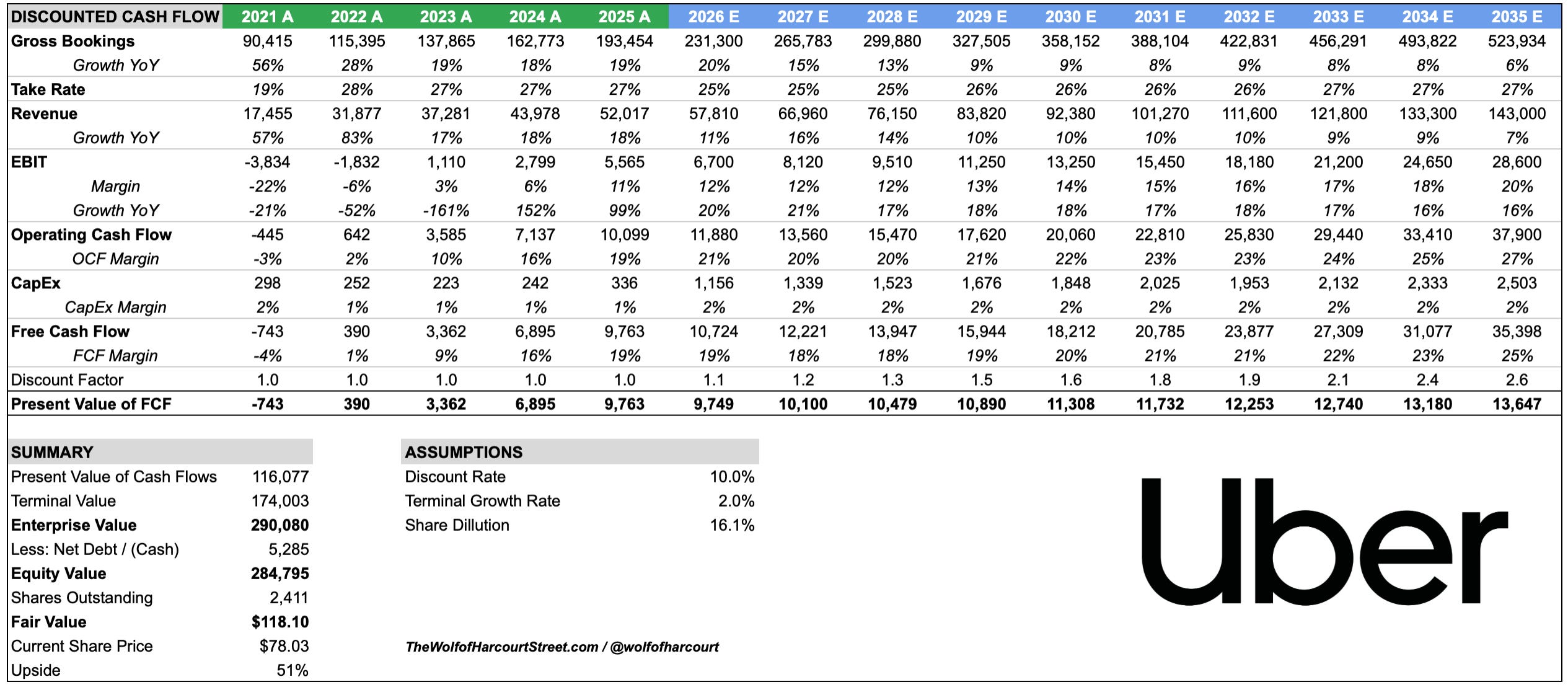
Putting it all together, I get to a fair value of about $118.10 per share, or roughly 51% upside from the $78.03 close on 10 August 2026.
That’s slightly higher than last year, but not because I’ve pushed assumptions. If anything, they’re a bit more conservative in places. The difference is simply that the business has outperformed the prior model.
Conclusion
The biggest swing factor remains autonomous vehicles, but the story around it has changed quite a bit.
A year ago, I leaned heavily on Uber’s partnership with Waymo as evidence that Uber was well positioned to benefit from AV adoption.
That relationship is now less stable.
Waymo has let its Phoenix exclusivity lapse and has signalled plans to launch its own app in Austin and Atlanta in 2028, effectively ending exclusivity in those markets. Existing vehicles will still operate on Uber’s platform through at least 2028, but the direction of travel is clear.
There have also been reports of friction around economics and safety data sharing between the two companies.
Uber’s response has been to broaden the base rather than rely on any single partner.
It now has 30+ AV partnerships, including Nuro/Lucid (20,000+ vehicles), Rivian (up to 50,000), plus a range of others like Avride, Motional, WeRide, and Wayve.
Management’s framing has also evolved. In the latest results, they described Uber as having “a clear path to becoming the largest facilitator of AV trips globally.”
That’s a shift, from being tied to a few key partners, to trying to sit as the demand layer across the entire ecosystem.
I still think that’s the right strategic direction.
But it does mean Uber is taking on more capital and more operational exposure than the original asset-light narrative implied. That’s part of why I’ve trimmed long-term margins in the model.
On top of that, there’s the Delivery Hero deal: a $14.8 billion all-cash acquisition that would significantly expand Uber’s delivery footprint. It’s expected to be EPS accretive, with high-single-digit accretion by year three.
I’ve left it out of the DCF for now given timing and regulatory uncertainty, but it’s clearly a potential upside lever.
Now, to sanity-check the downside.
If you assume the Waymo split is just the beginning of broader AV disruption in Mobility (which is still about half of Uber’s bookings), you could reasonably cut the terminal value in half—from $174 billion to $87 billion.
Even under that fairly harsh scenario, the model still comes out at about $80.94 per share, which is still slightly above where the stock trades today.
So even in a stressed AV case, you’re not obviously below current price levels.
That tells me the market is already pricing in a fair amount of this risk, possibly more than is warranted given Uber is still growing bookings at ~19% and generating record free cash flow.
I still think the stock is undervalued, and I’m still a buyer.
But the range of outcomes is wider than it was a year ago.
The base case is better. The downside is more real.
And that combination is usually where things get interesting.
If you'd like to support the work of an independent analyst, you can buy me a coffee. The proceeds will contribute to covering the annual running costs of the newsletter.
Join the community of informed investors – subscribe now to receive the latest content straight to your inbox each week and never miss out on valuable investment insights.
The Chat is a space designed to facilitate, real-time discussions, share knowledge and debate ideas with fellow investors. Join the conversation.

If you found today's edition helpful, please consider sharing it with your friends and colleagues on social media or via email. Your support helps to continue to provide this newsletter for FREE!
Happy investing
Wolf of Harcourt Street
Contact me
Twitter: @wolfofharcourt
Email: wolfofharcourtstreet@gmail.com