
Adyen's stock is down 41% since my last valuation update in March 2025, when I concluded it was trading above fair value at €1,450. Today, at around €836, the market is pricing in a very different story than it was sixteen months ago.

For context, this is a stock I first pitched in August 2023, at the depths of the sell-off, and one I’ve held through the entire round trip, the 106% rally into March 2025, followed by the sharp decline that came after. If you’ve been holding alongside me, this has been an uncomfortable stretch. But discomfort is often where the most interesting investment decisions are made.
So the question for this update is simple:
Has Adyen become cheap again, or is the market correctly repricing a slower growth future?
This analysis is based on Adyen’s H2 and full-year 2025 results, published in February 2026, together with management’s 2026 guidance and commentary from November’s Investor Day.
The Backdrop
Full-year 2025 net revenue came in at €2.36 billion, up 18% year over year on a reported basis, or 21% in constant currency.
The headline numbers, however, mask the more important story.
Throughout 2025, management reduced its outlook for 2026 constant currency revenue growth twice. Guidance moved from low-to-high 20%, to low-to-mid 20%, before settling at 20-22% alongside the Q1 2026 business update.
That is the primary reason the stock has spent the past year in the doghouse. Markets rarely reward companies whose growth expectations continue to drift lower, even when the absolute numbers remain exceptional.
Underneath the surface, though, the business continued to execute well.
EBITDA margin reached 53%, up from 50% in 2024, comfortably ahead of management’s previous “above 50% by 2026” target and above my own 52% assumption from last year’s model.
Free cash flow conversion came in at 87%, while CapEx remained at its typical 5% of net revenue.
Take rate improved to 17.1 basis points in H2 2025, up from 16.2 basis points a year earlier, driven by a more favourable customer mix.
Processed volume increased 8% to €1.39 trillion, although that figure is distorted by the unwind of one large volume customer. Excluding that impact, processed volume grew 21%, which is the number that matters for the valuation.
Investor Day also provided a glimpse of Adyen’s next growth chapter.
Management introduced Dynamic Identification, an intelligence layer built on trillions of payment transactions, alongside an early push into agentic commerce, where AI agents initiate payments on behalf of customers.
Neither initiative is likely to move revenue meaningfully in the near term, but both fit naturally within Adyen’s single-platform strategy. As AI shopping assistants become more common, merchants will increasingly want to preserve ownership of the customer relationship. Adyen is positioning itself as the infrastructure that allows them to do exactly that.
For 2026, management is guiding for 20-22% constant currency revenue growth, an EBITDA margin broadly in line with 2025, and 550-650 net new hires, primarily across the United States and global technology hubs. It’s another reminder that today’s margins are a management decision, not the ceiling of the business.
Discounted Cash Flow Analysis
I‘m using the same valuation framework as last year: a 10-year explicit forecast, discounted at 10%, with a 2.5% terminal growth rate reflecting Adyen’s long-term ability to price broadly in line with inflation.
Extending the model to ten years remains the right approach. It reduces, although certainly doesn’t eliminate, the influence of the terminal value, where small assumption changes can have an outsized impact on valuation.
Revenue
Revenue is modelled as processed volume multiplied by take rate.
Growth starts at 21% in 2026, consistent with management guidance, before gradually slowing to 9% by 2035. That produces a 10-year revenue CAGR of roughly 14%, down from the 16% CAGR I used in last year’s model.
The reduction is deliberate.
Management’s guidance has trended lower rather than higher throughout 2025. Competition from Stripe and PayPal remains intense. And Adyen’s land-and-expand strategy is now compounding from a much larger revenue base than it was only a few years ago.
For perspective, the global payment processing market is expected to grow from $173 billion in 2025 to $1.05 trillion by 2035, representing approximately 20% CAGR. My assumptions still require Adyen to continue taking market share, just not at an unrealistic pace.
EBITDA
I project EBITDA margin at 53% in 2026, consistent with management guidance.
Margins then expand beyond 54% by 2028, matching management’s long-term target, before reaching 58% by year ten as operating leverage continues to play out.
I’m leaving the long-term margin assumption unchanged from last year. Adyen has never guided towards a return to the 60%+ margins briefly achieved during 2021, and neither am I.
CapEx and Dilution
CapEx remains at 5% of net revenue throughout the forecast period, consistent with both management guidance and the seven-year historical average.
Applying the 87% free cash flow conversion achieved in 2025 produces a free cash flow margin that rises from roughly 46% in 2026 to just over 51% by 2035.
I assume cumulative dilution of 3% over the full ten-year period.
Adyen’s share-based compensation remains modest relative to most US technology companies, partly reflecting Dutch compensation practices. However, this is the assumption most likely to drift higher over time as hiring accelerates in the United States, making it something to reassess each year rather than treat as a fixed input.
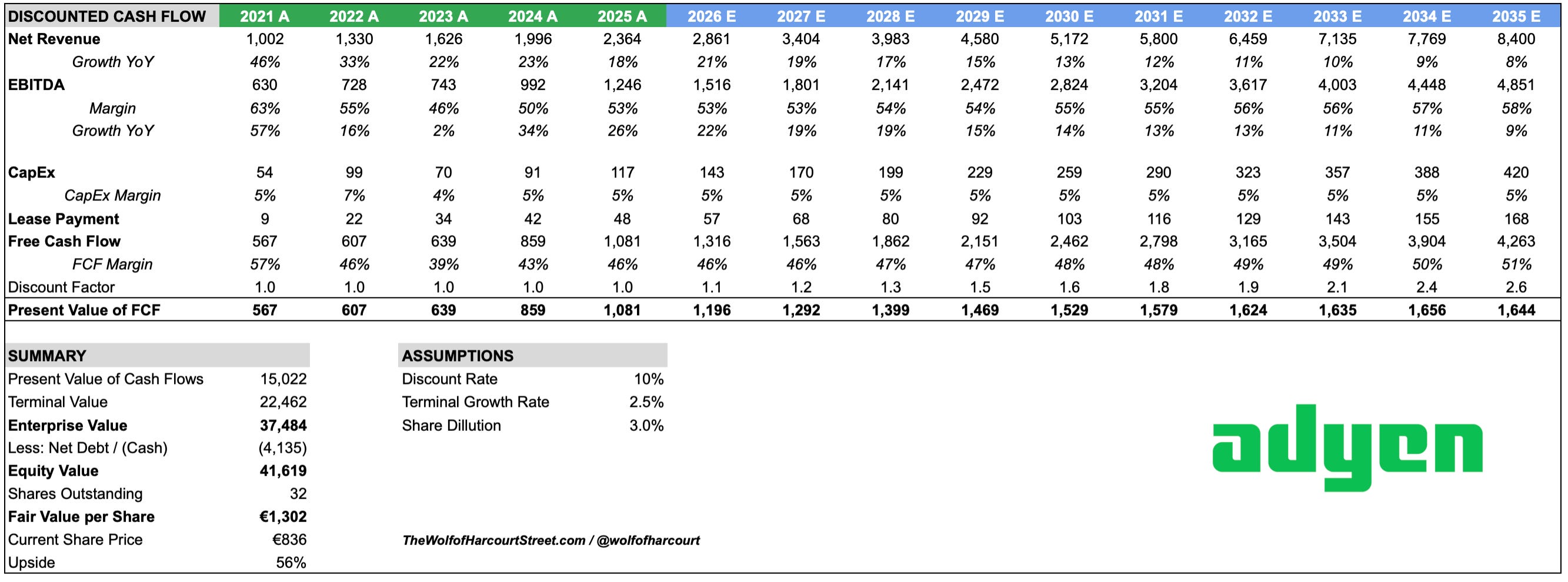
Running these assumptions through the model produces a fair value of €1,302 per share.
Against today’s share price of €836, that implies approximately 56% upside.
That is a very different conclusion from last year’s above fair value rating.
The change isn’t because I’ve become more optimistic about the business. If anything, my growth assumptions are now more conservative.
Instead, the share price has fallen far more than the underlying fundamentals have deteriorated, if they’ve deteriorated at all.
Conclusion
Last year’s analysis concluded that Adyen was a hold, not an attractive place to deploy new capital.
This year’s analysis reaches the opposite conclusion, not because the business has fundamentally improved, but because the valuation has become far more compelling.
At €836, the market appears to be pricing in a much slower long-term growth trajectory than even my more conservative assumptions require.
That doesn’t eliminate the risks.
Management has already reduced its 2026 growth outlook twice, and another disappointment would almost certainly pressure the stock again.
Competition from Stripe and PayPal remains intense.
And while agentic commerce could eventually become an important opportunity, it is still exactly that, an opportunity. Today it represents strategic optionality, not an earnings driver, and I assign it no additional value in this model.
If you'd like to support the work of an independent analyst, you can buy me a coffee. The proceeds will contribute to covering the annual running costs of the newsletter.
Join the community of informed investors – subscribe now to receive the latest content straight to your inbox each week and never miss out on valuable investment insights.
The Chat is a space designed to facilitate, real-time discussions, share knowledge and debate ideas with fellow investors. Join the conversation

If you found today's edition helpful, please consider sharing it with your friends and colleagues on social media or via email. Your support helps to continue to provide this newsletter for FREE!
Happy investing
Wolf of Harcourt Street
Contact me
Twitter: @wolfofharcourt
Email: wolfofharcourtstreet@gmail.com
One of the European high quality names I have yet to take a closer look at! I know so many quality-focused investors who like the business a lot.
I really like Adyen at this level. If there weren't any uncertainty, the stock price would be somewhere else entirely. But that's exactly where the opportunity lies. Although, to be honest, I think the level of uncertainty is way overblown. I really like the company's VERY long-term approach. It's countercyclical by nature.