

Last September, I wrote about one of the most underappreciated parts of the NU investment thesis.
NU’s data showed that a customer who generated $0.80 of monthly revenue in their first month would generate more than $27 per month after eight years. That is a 34x increase in revenue per customer.

At the time, I used Q2 2025 data to ask a simple question:
What happens to revenue if only NU’s existing customers mature?
The 123 million customers Nu had could, based on the cohort data, have generated $37 billion of annual revenue by 2030, assuming the ARPAC curve remained unchanged.
One year later, the customers have matured. The ARPAC curve has moved higher and NU has added another 16 million customers on top of the 123 million it had.
The market often focuses on NU’s customer additions but I think the more interesting question is:
What are those customers worth five years from now?
The Cohort Curve Has Moved Higher
The idea behind this analysis is straightforward. NU discloses monthly ARPAC by customer cohort, allowing us to see how much revenue customers generate as they spend more time on the platform. In Q2 2025, the data already looked compelling.
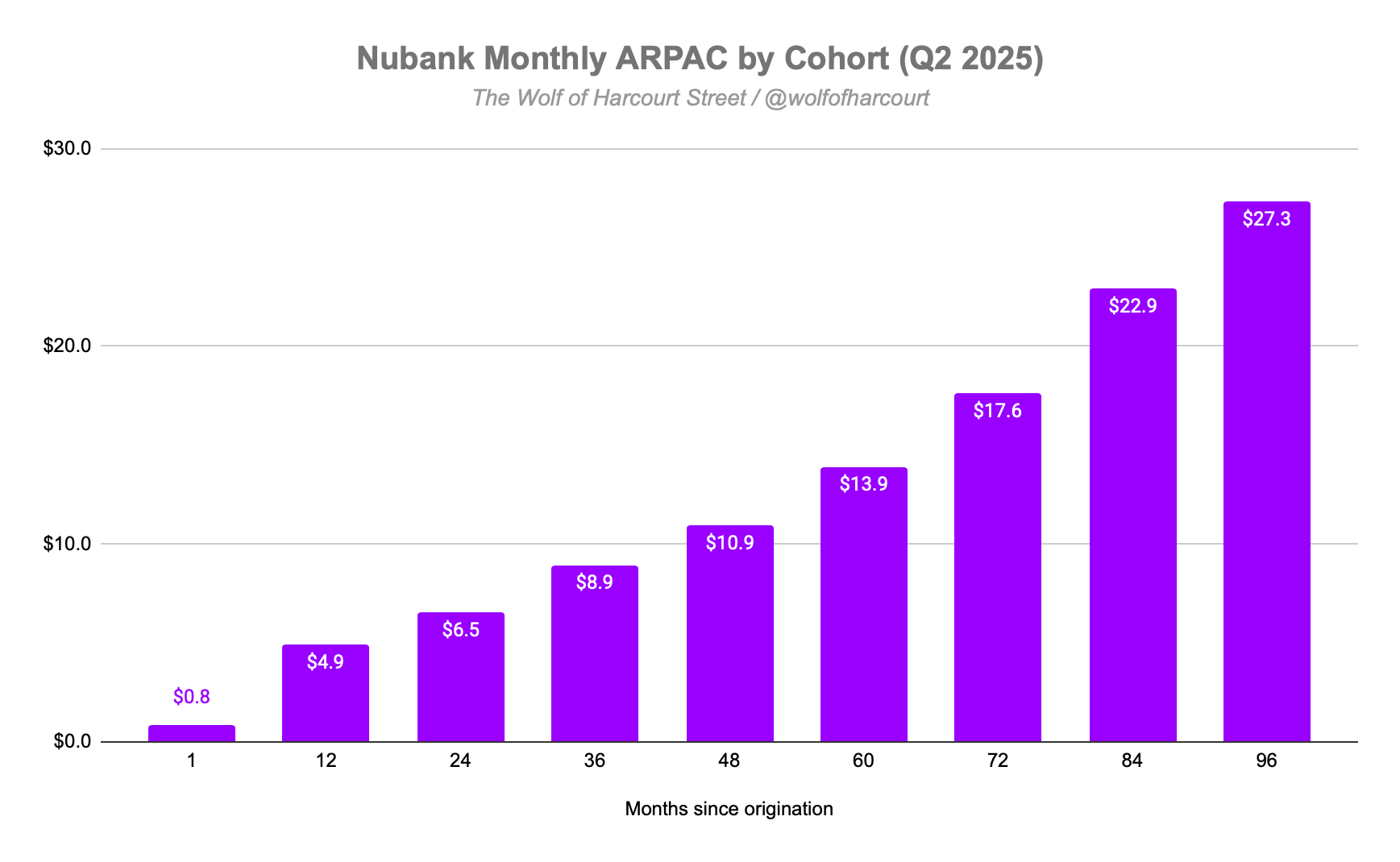
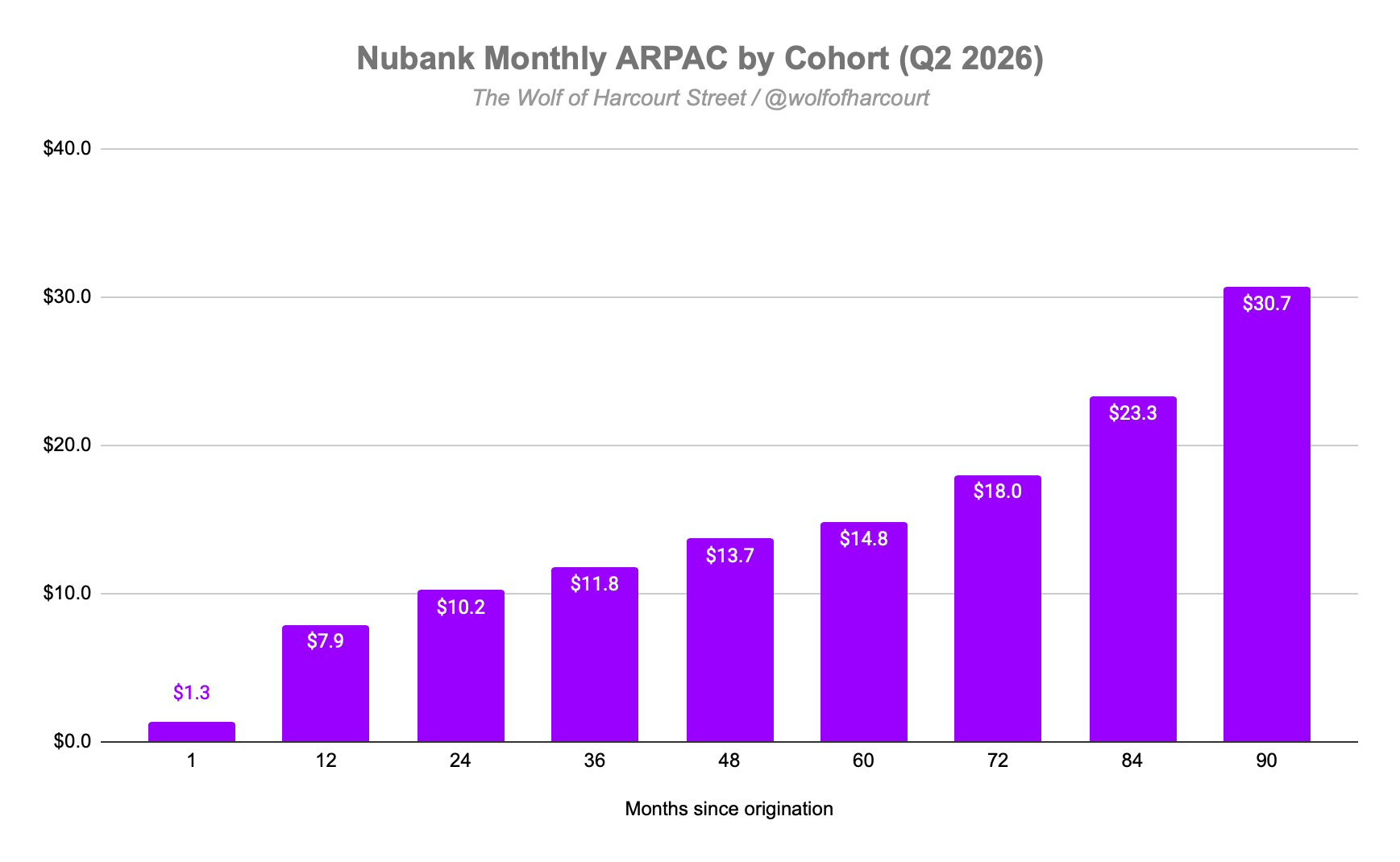
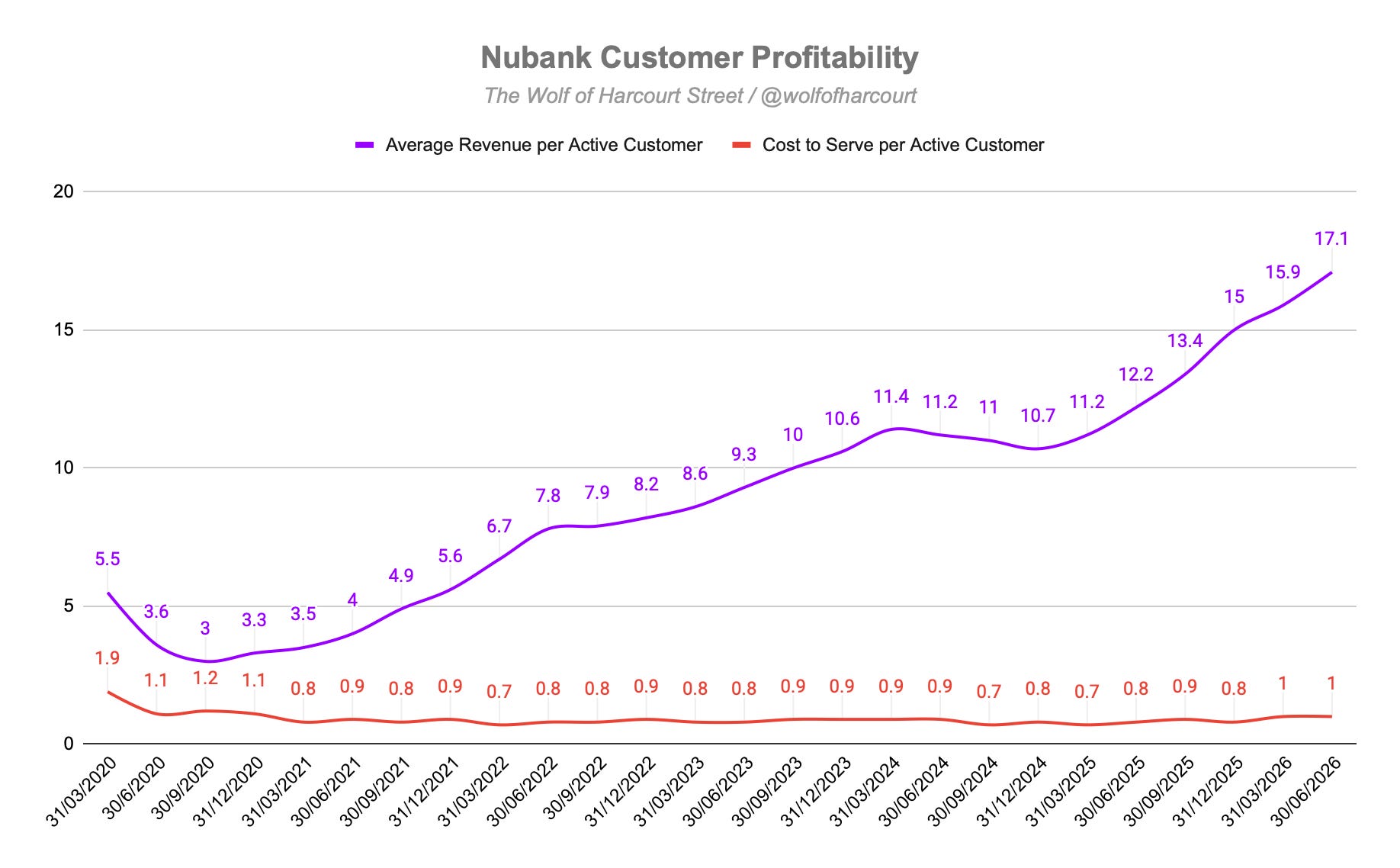
By Q2 2026, NU’s mature cohort ARPAC had risen to $30.80 per month, versus $27.30 in Q2 2025. Overall monthly ARPAC had also climbed to $17.10, up 40% YoY.
NU also finished Q2 with 139 million customers, after adding four million during the quarter.
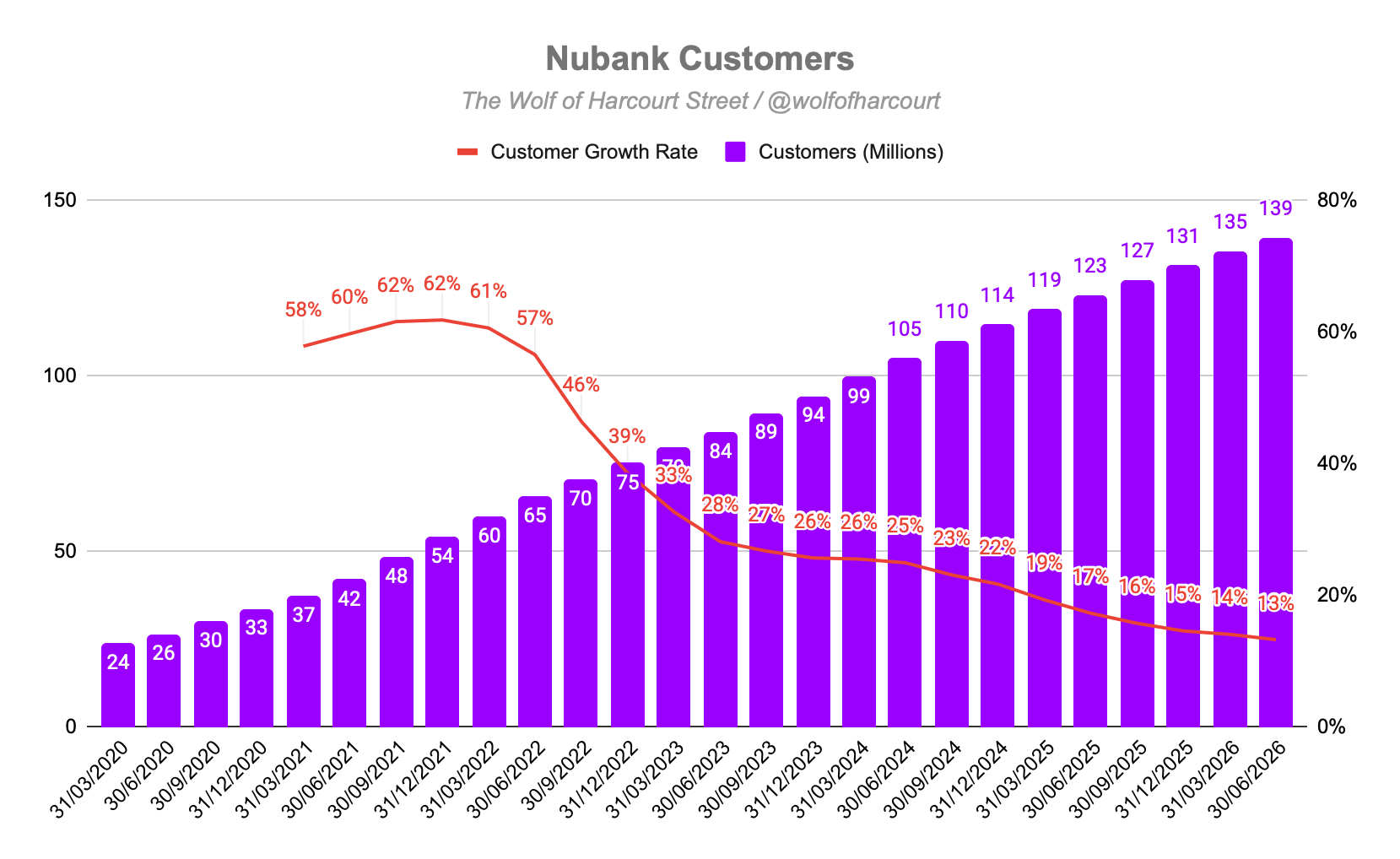
The company is doing two things at the same time: Growing the number of customers while increasing the amount of revenue it generates from each one.
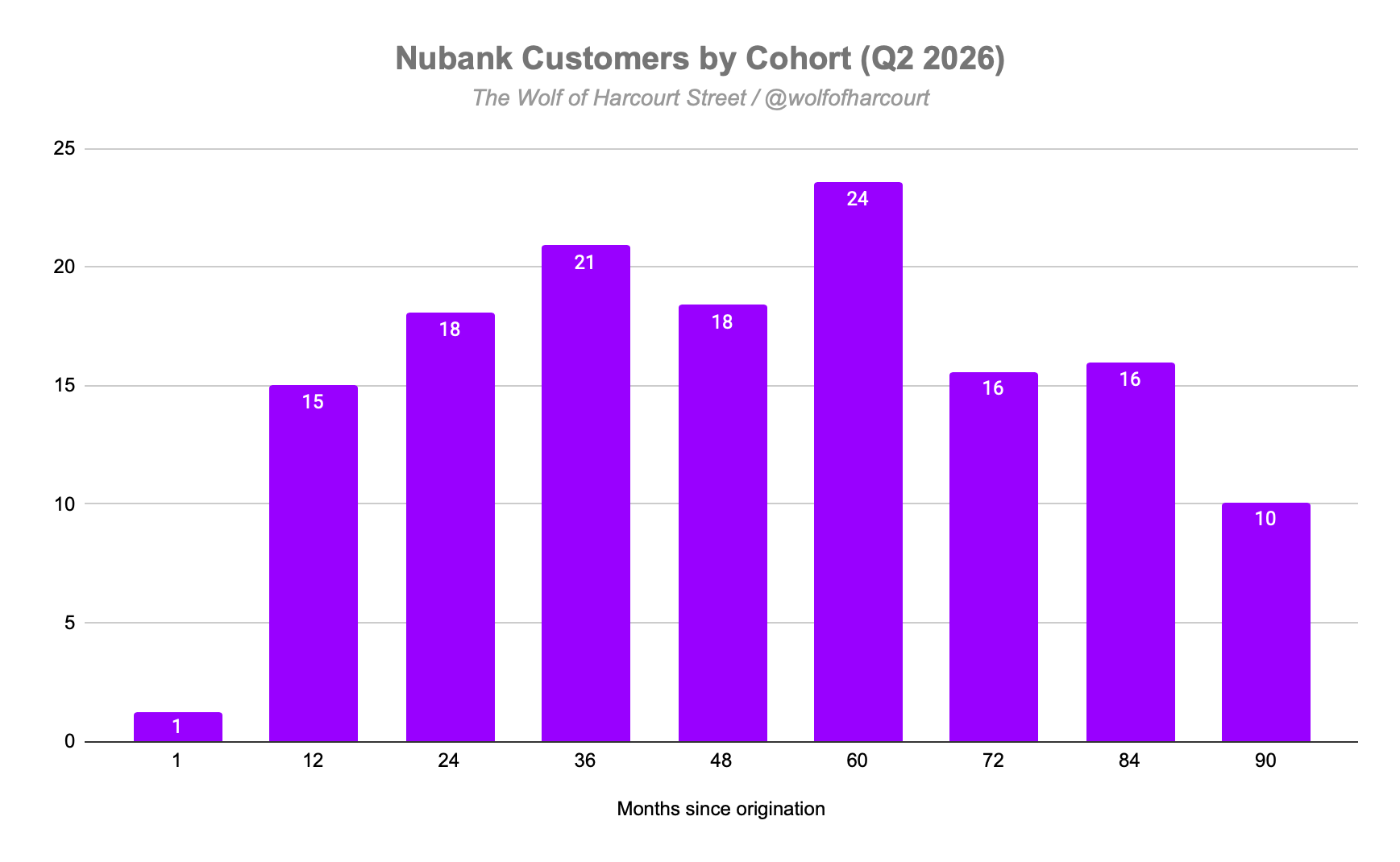
One year later, the customer base is still extremely young. This is where the cohort analysis becomes even more important. A significant proportion of NU’s customers have not been with the company long enough to reach the higher end of the ARPAC curve.
Think about the difference between a customer generating approximately $5 per month and one generating $25. The customer has not become five times more expensive for NU to serve. They have simply become more engaged. More products. More deposits. More borrowing. More transactions. A greater proportion of their financial life taking place within the NU ecosystem.
At the same time, cost to serve remains around $1, meaning the economics of monetising an increasingly mature customer is extremely attractive.
What Has Changed Since Last Year's Analysis?
1. Mature customers are worth more
When I ran the analysis last year, the mature customer ARPAC was $27.30. The mature cohort reached $30.80 by Q2 2026, an increase of roughly 13% in less than a year.
A customer who has spent eight years on the platform is generating more revenue today than an equivalent mature customer was generating one year earlier.
If the curve itself continues moving higher, simply ageing the existing customer base could actually understate the revenue opportunity.
2. Overall ARPAC is accelerating
The second development is the movement in Nu’s headline ARPAC.
Q2 2025: $12.20
Q4 2025: $15.00
Q2 2026: $17.10
It means NU is not relying exclusively on adding millions of new, low-ARPAC customers to grow revenue. The existing customer base is becoming more valuable too. That becomes increasingly important as the company gets larger. Eventually, customer growth will slow. It is inevitable.
But NU does not need customer growth to remain at today’s levels indefinitely. It can increasingly rely on monetisation of the customer base it already has.
3. The starting point for the 2031 calculation is now much larger
This is the other part of the equation that has changed. Last year’s analysis started with approximately 123 million customers. Today, NU has approximately 139 million. An additional 16 million customers will also mature.
What Could NU's Customers Generate in 2031?
The simplest way to think about it is to take today’s customer base and move each cohort forward five years, while applying the observed ARPAC curve to each cohort based on its expected tenure.
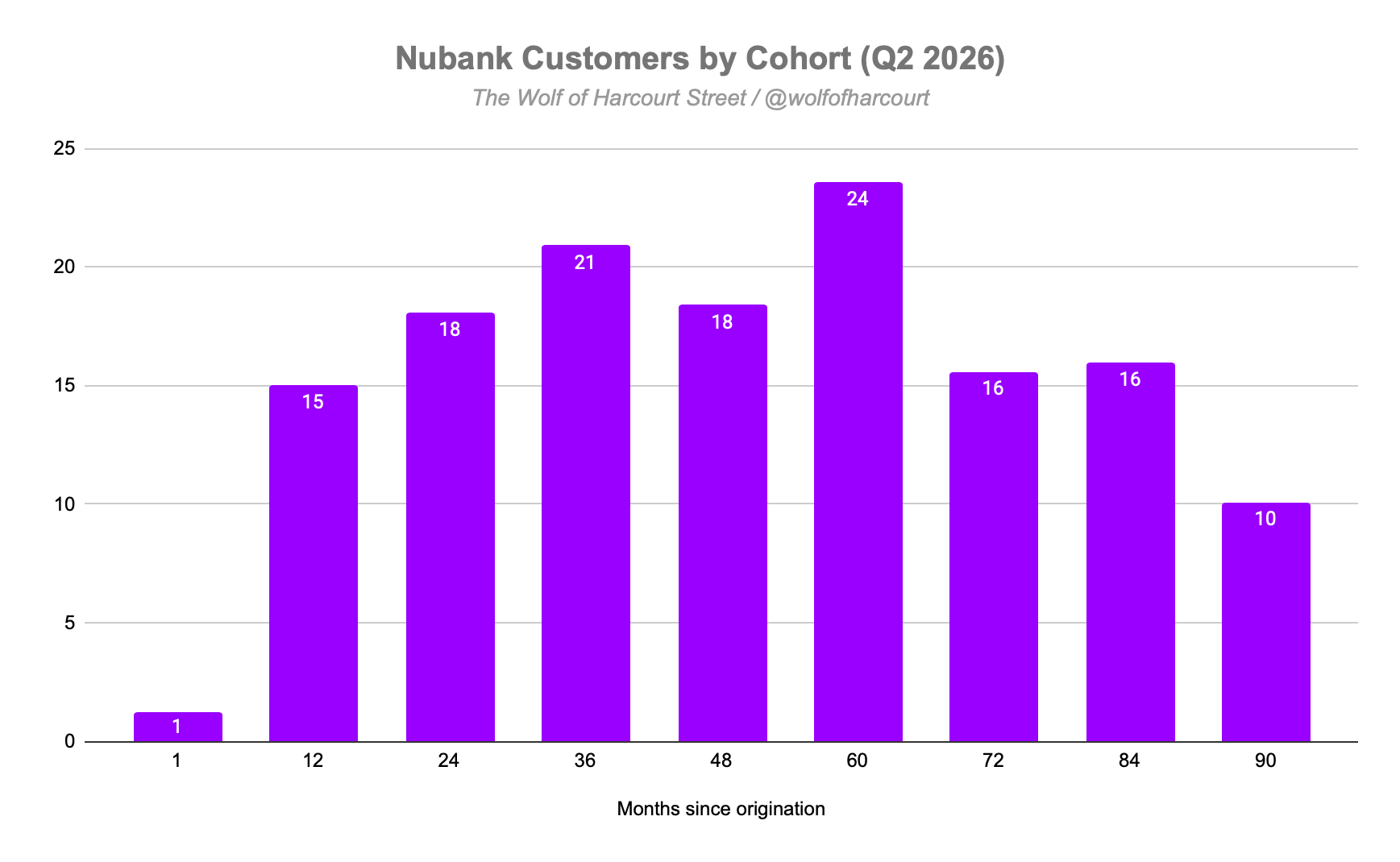
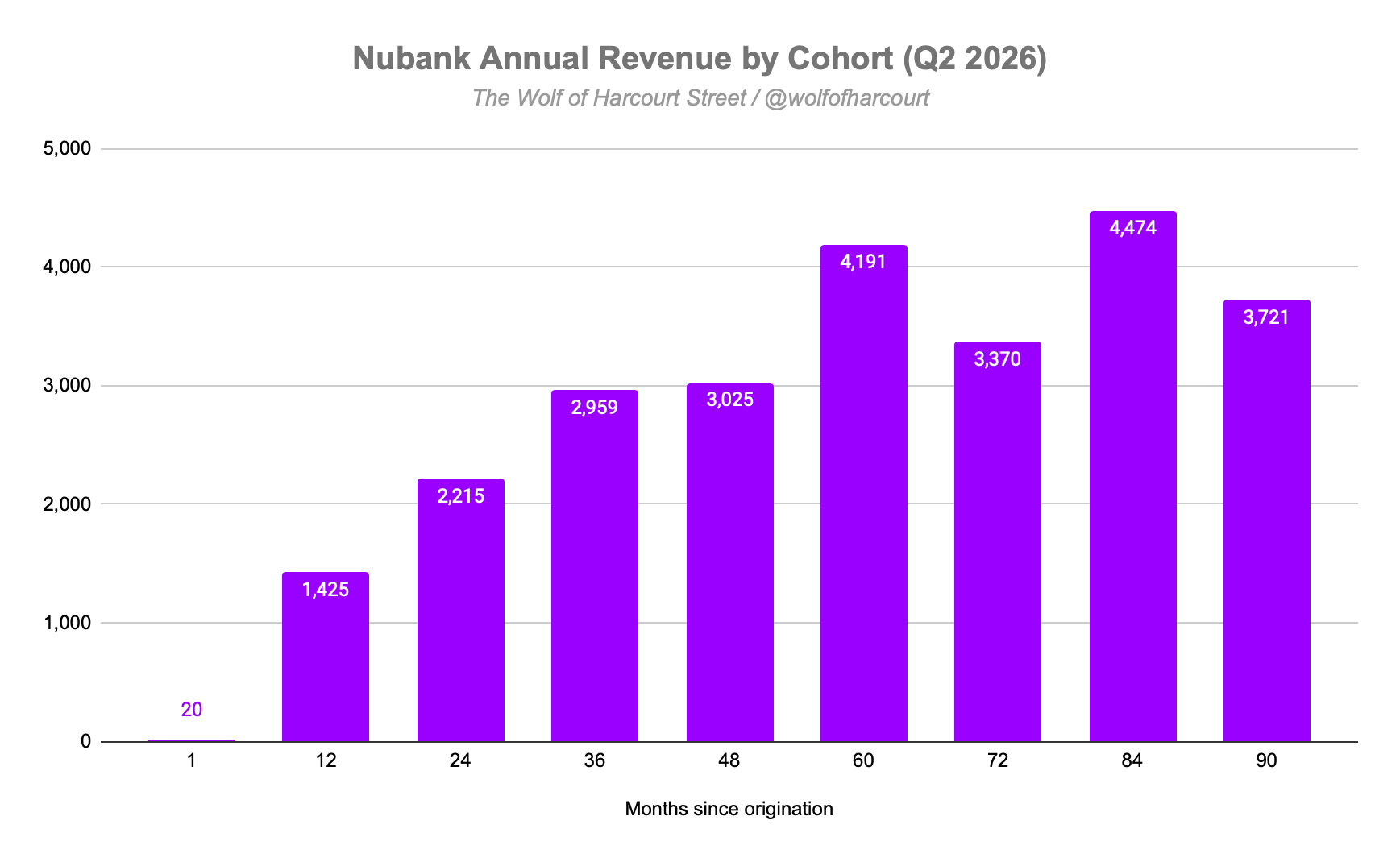
This is not a traditional revenue forecast. There is no assumption that NU acquires another customer. There is no assumption that the company increases its market share. There is no assumption that Mexico or Colombia suddenly become enormous businesses. It is simply a thought experiment:
What happens if the customers NU already has continue ageing through the existing monetisation curve?
Based on the cohort framework, NU’s existing customer base could generate $47 billion of annual revenue by 2031 as those customers mature.
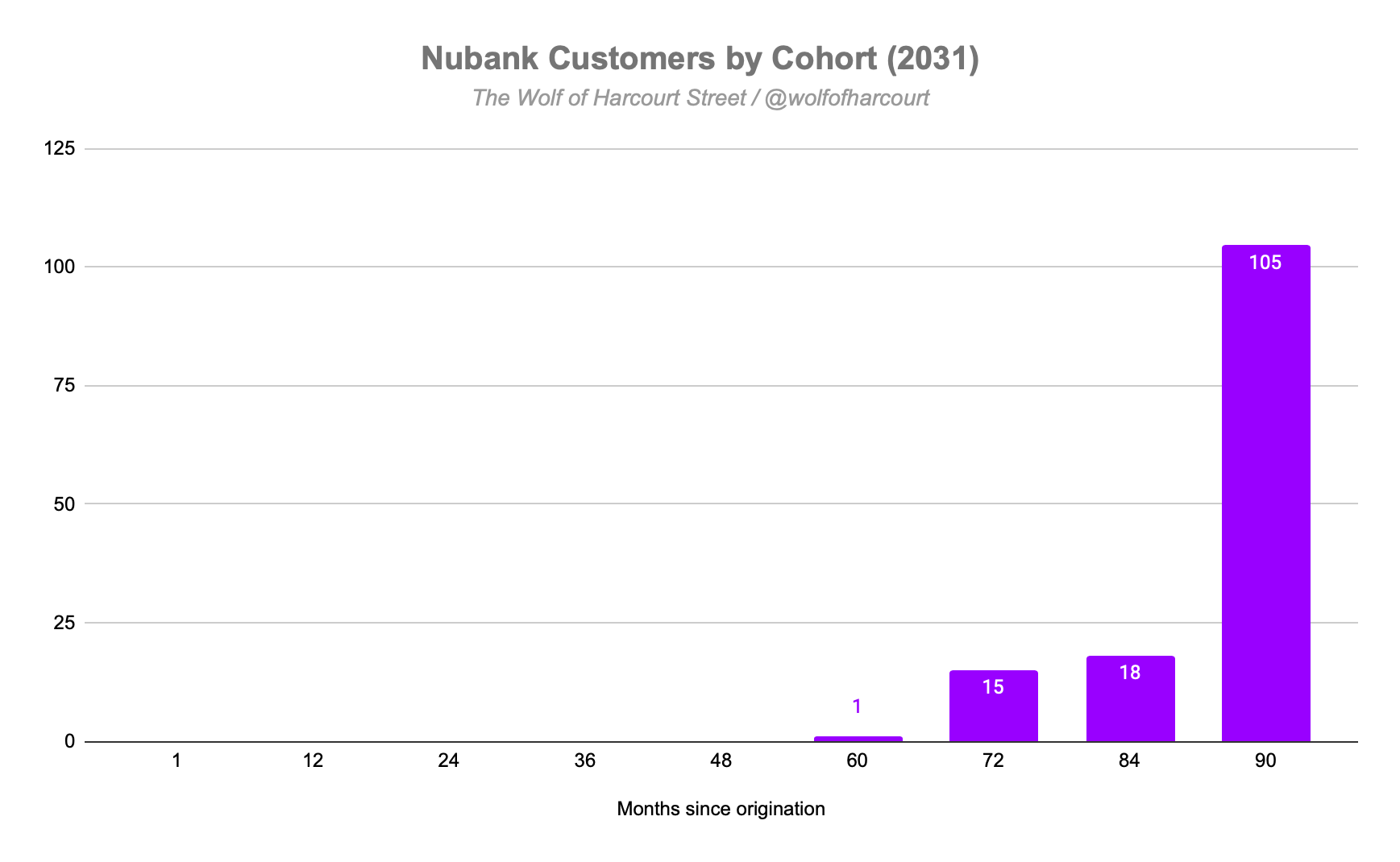
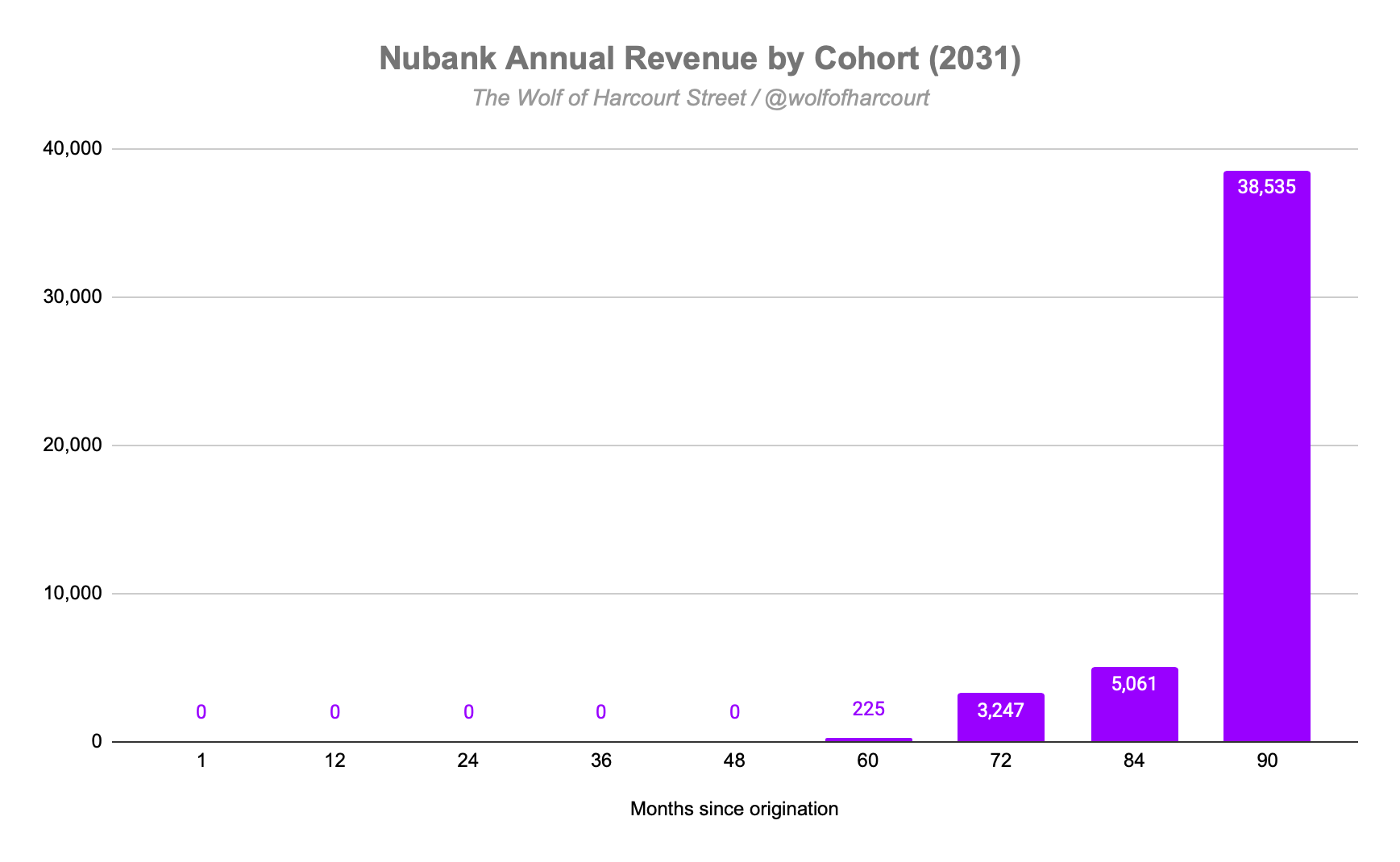
That would represent 3x the $15.8 billion of revenue NU generated in 2025, before accounting for any contribution from new customers acquired between now and 2031.
The $47 billion figure does not require NU to have 250 million customers. It does not require every customer to become a super-user. It does not require the company to dominate every financial product category in Latin America.
The customer base NU has already built is still working its way up the monetisation curve. Today, a huge portion of NU’s customer base contributes relatively little revenue. The important question is whether those customers stick around long enough to move up the curve. So far, the evidence suggests they do.
In the Q2 2026 analysis, customers with less than three years of tenure represented roughly 40% of customers but only around 24% of revenue. Customers with more than five years of tenure represented approximately 47% of customers but generated 62% of revenue. By 2031, a much larger proportion of NU’s customers will sit in the high-ARPAC portion of the curve.
The company therefore gets a structural tailwind from something remarkably simple: time.
An Important Caveat
The ARPAC curve is unlikely to remain static.
The obvious downside is that credit losses, macroeconomic conditions or weaker customer engagement could prevent mature ARPAC from reaching the levels implied by today’s cohorts.
NU’s revenue is still heavily influenced by its credit business, and the company operates across markets with meaningful currency and economic volatility.
Q2 2026 was another reminder of this. Revenue reached $5.5 billion while the credit portfolio reached $39.4 billion. However, NU’s credit performance still needs to be monitored carefully, with the 90+ day NPL ratio remaining elevated relative to the company’s historical levels.
The ARPAC curve continuing to move higher is arguably more interesting. NU keeps adding products. Credit limits increase. Customers use NU as their primary bank. Mexico and Colombia are still relatively early in their maturation curves. Layer in NU using AI to improve underwriting, collections and customer engagement.
The fact that mature ARPAC increased from $27.30 to $30.80 in less than a year suggests the curve is not even close to a ceiling. The headline numbers are impressive but the more interesting story sits underneath those numbers.
NU has spent years building a customer base. Those customers are now moving through a monetisation curve that becomes dramatically more valuable with time. The company is then adding millions of new customers behind them.
New customers enter at low ARPAC. They become increasingly engaged. They adopt additional products. Revenue per customer rises. The oldest customers become extremely valuable. New customers replace them at the bottom of the curve.
That is a fundamentally different growth model from one where revenue growth depends on continuously acquiring new users. Continuously acquiring new users is expensive unless you are NU of course who acquire the majority of theirs through word of mouth referrals.
Conclusion
The $47 billion figure is not a prediction of where NU’s revenue will be in 2031. Rather, it is a framework for understanding the embedded value in the customer base.
There are obviously countless variables between here and 2031. NU will acquire more customers. Some customers will leave. ARPAC will change. Credit conditions will change. New products will launch. Regulation will change. Mexico could become significantly more important. The United States could either become a major opportunity or an expensive experiment.
While all of those variables matter, the most important takeaway from the cohort data is simpler.
NU does not need to reinvent the business to generate substantial revenue growth.
A significant portion of that growth is already embedded in the customers it has acquired. Last year, I argued that NU’s existing 123 million customers could potentially generate around $37 billion of annual revenue by 2030. One year later, the customer base is larger, ARPAC is higher and the mature cohorts are generating more revenue than they were when I ran the original analysis.
If you'd like to support the work of an independent analyst, you can buy me a coffee. The proceeds will contribute to covering the annual running costs of the newsletter.
Join the community of informed investors – subscribe now to receive the latest content straight to your inbox each week and never miss out on valuable investment insights.
The Chat is a space designed to facilitate, real-time discussions, share knowledge and debate ideas with fellow investors. Join the conversation.

If you found today's edition helpful, please consider sharing it with your friends and colleagues on social media or via email. Your support helps to continue to provide this newsletter for FREE!
Happy investing
Wolf of Harcourt Street
Contact me
Twitter: @wolfofharcourt
Email: wolfofharcourtstreet@gmail.com
That is an interesting way of thinking. To be a bit more sure we have to understand what is driving this average revenue up so much after 8 years, I dont know, like mortgages, and see if new cohorts have the same demographic than the first timers. Maybe the new cohorts don't need these high ARP product, use it more as a secondary bank or third bank. I dont know.
Curious if tripling 2025 revenue of $15.8b by 2031 is consistent or not with your NU model revenue growth or analyst expectation for long-term topline? That works out to ~20% cagr excluding new customer adds and their monetization path. When including those, the total growth seems high vs analyst consensus.